
Kettlebell Leg Workout: Swing and Goblet Squat for the Full Lower Body
Kettlebell leg training builds the quads, glutes, and hamstrings. The kettlebell goblet squat: hold the bell at your chest and squat to parallel. The kettlebell swing: hinge at the hips and swing the bell to shoulder height, driving with your glutes. These movements build powerful legs and explosive hip extension.
Why the Kettlebell Is Built for Posterior Chain Training
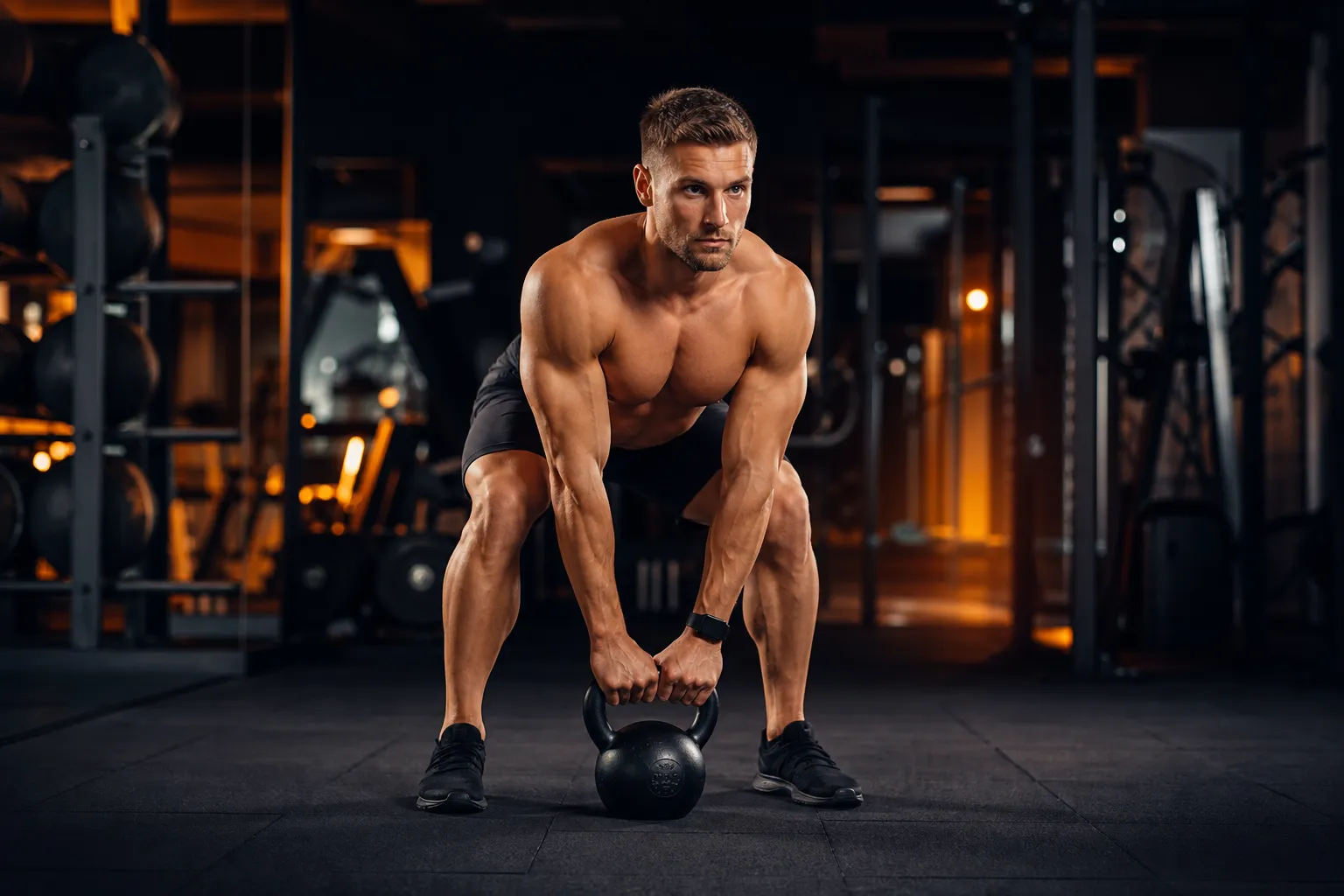
The kettlebell is the single best tool ever designed for posterior chain training. Its offset center of mass — the weight hangs below the handle, not in line with it — turns every hinge movement into a guided pendulum. The kettlebell swing in particular trains the glutes, hamstrings, and lower back with a ballistic hip drive that no other piece of equipment matches at the same load. Pair the swing with the goblet squat, and you have a complete two-exercise lower-body system that hits both hinge and squat patterns.
Why the kettlebell over the dumbbell or barbell for these movements? A 2012 study published in the Journal of Strength and Conditioning Research found that the two-handed kettlebell swing produced gluteus medius and hamstring activation comparable to conventional deadlifts performed at heavier absolute loads — but with a fraction of the spinal compression. The goblet squat with a kettlebell encourages a more upright torso and deeper range of motion than the same exercise with a dumbbell, because the bell sits closer to the chest and acts as a counterweight.
This guide breaks down the two exercises that build the kettlebell foundation. Master these and you have a complete leg workout in two movements — no rack, no spotter, no excuses.
Kettlebell Swing: Step-by-Step Form (Hip Hinge)
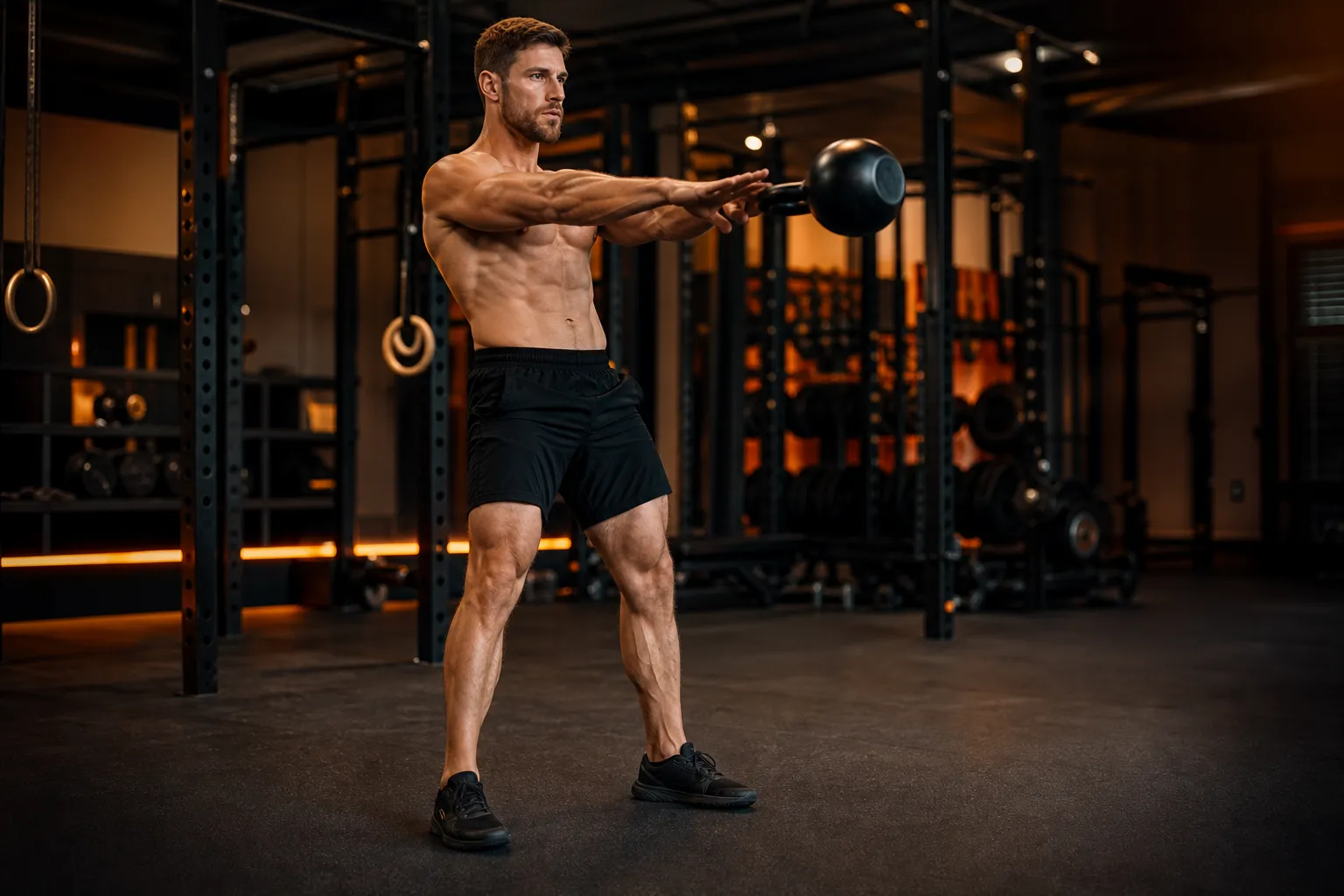
The kettlebell swing targets the gluteus maximus, hamstrings, erector spinae, latissimus dorsi, and grip — making it the most complete posterior chain ballistic exercise you can do. It is a hip hinge, not a squat, and not a front raise. The arms are passive; the hips do the work.
Step 1 — Setup and Stance
Place the kettlebell on the floor about a foot in front of you. Stand with your feet slightly wider than shoulder-width, toes pointed straight ahead or slightly out. Hinge at the hips and grip the handle with both hands, thumbs pointing back toward you. With straight arms, tilt the bell back so the handle is angled toward your hips — this is the "hike pass" position, identical to a quarterback hiking a football. Your back should be flat, chest proud, lats engaged.
Step 2 — The Hike
Pull the bell back through your legs in a sharp, aggressive motion. Your forearms should make firm contact with your inner thighs, and the bell should travel high and tight — above the knees, not down at ankle level. This is the loaded position. Your hamstrings are now stretched and your hips are loaded with elastic tension, like a coiled spring.
Step 3 — Hip Drive (Concentric)
Drive your hips forward explosively, contracting your glutes hard at the top. The bell floats up to roughly chest height — it does not require any arm pull. The lockout position should look like a tall, vertical plank: glutes squeezed, quads tensed, abs braced, ribs down. Your arms remain straight throughout. In my experience coaching beginners, the biggest mistake at this stage is trying to lift the bell with the shoulders. The cue I use: "the bell is a passenger, the hips are the engine."
Step 4 — The Float and the Return
At the top of the swing, the bell will momentarily feel weightless. Let it fall back down on the same path it came up on. As it approaches your hips, hinge again — push your hips back, let the bell pass between your legs, and immediately reload for the next rep. Breathe out sharply through pursed lips at the top of each swing and inhale during the descent. Hardstyle swings are usually programmed in sets of 10-20 reps.
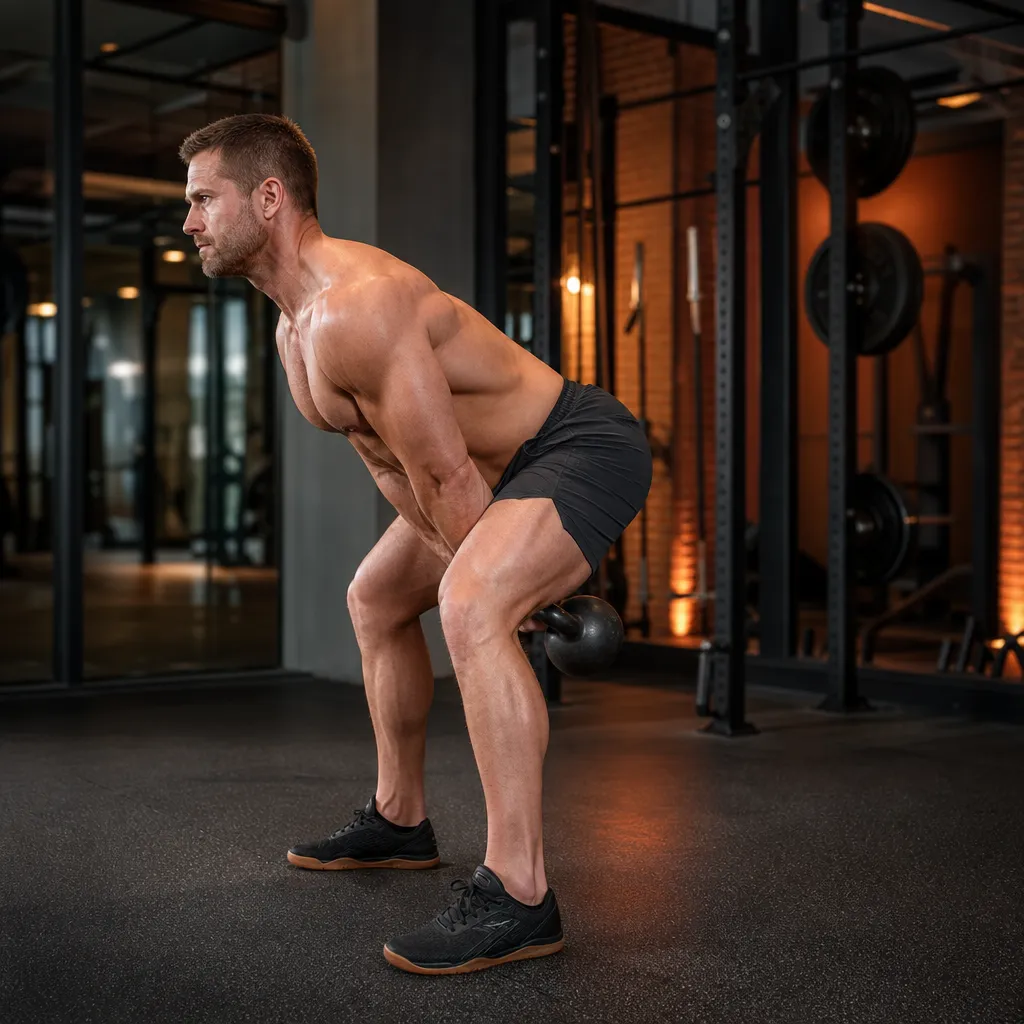
Kettlebell swing bottom hike position with hips loaded
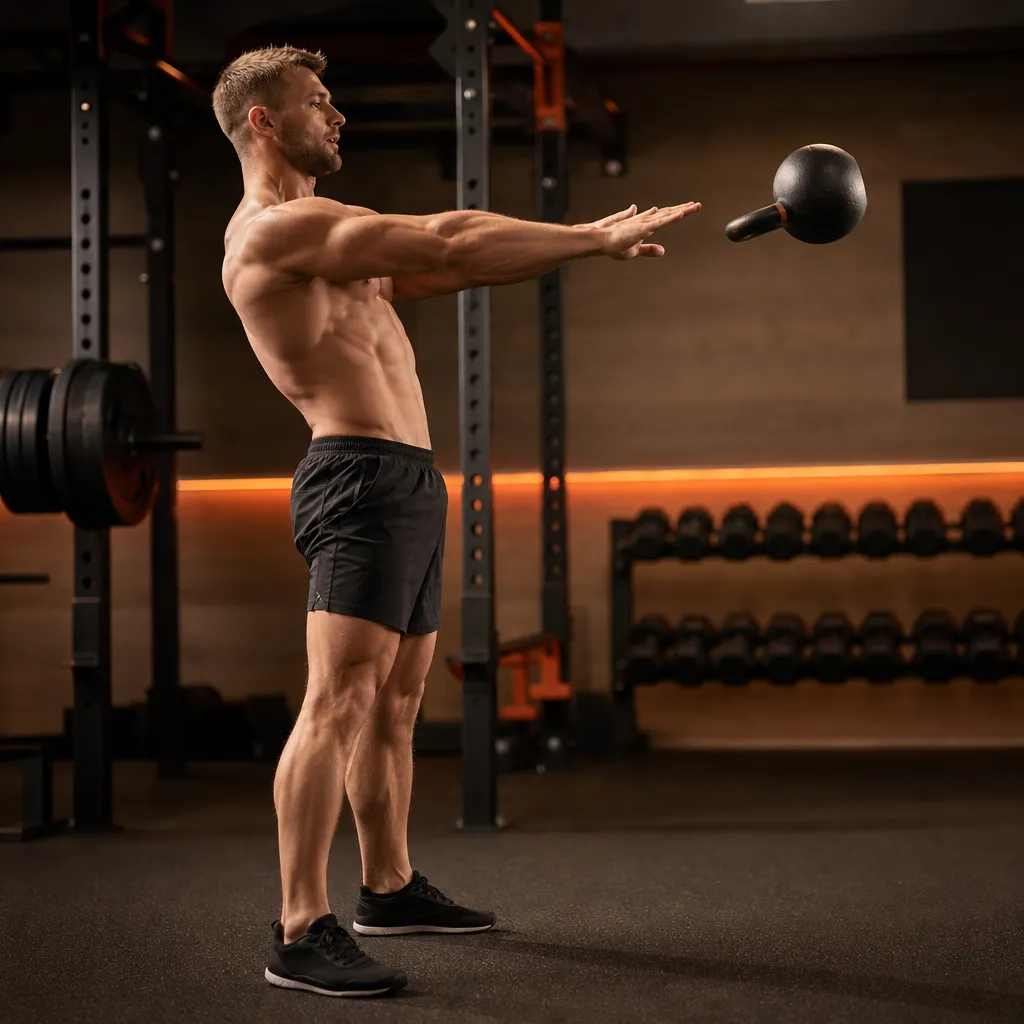
Kettlebell swing top position, bell floating at chest height
Kettlebell Goblet Squat: Step-by-Step Form
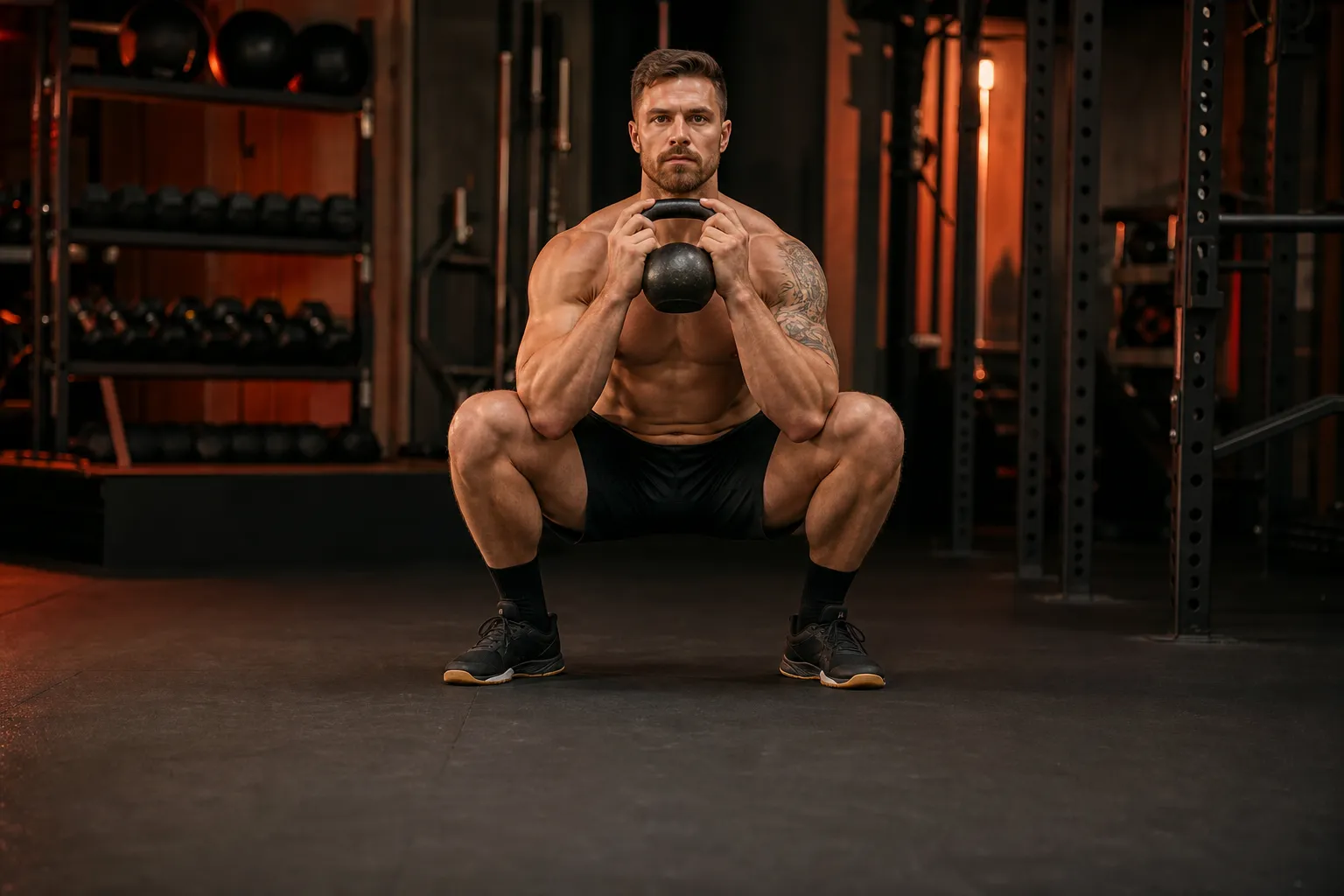
The goblet squat targets the quadriceps, gluteus maximus, adductors, and core. The kettlebell held at chest level acts as a counterweight, which lets most people achieve a deeper, more upright squat than they can with a barbell on their back. According to a 2018 EMG study in the International Journal of Sports Physical Therapy, the goblet squat produces quadriceps and glute activation within 90% of barbell back squats at equivalent relative intensities, with significantly less spinal load.
Step 1 — Grip and Setup
Hold the kettlebell vertically by the horns (the sides of the handle), close to your chest. Your elbows should point straight down, the bell resting against your sternum. Stand with your feet just outside shoulder-width, toes turned out 15-20 degrees. Brace your core hard before initiating the descent.
Step 2 — Descent (Eccentric)
Sit back and down between your hips, leading with your knees tracking outward over your toes. Keep your chest up — the kettlebell at your chest naturally cues this. Descend to the depth where your thighs are at least parallel to the floor, ideally with your hip crease below your knee. The "elbows inside knees" cue from Dan John works perfectly here: at the bottom, your elbows should slot just inside your knees, gently pushing them out.
Step 3 — Drive Up (Concentric)
Drive through the middle of your foot — not the toes, not the heels — and stand up. Squeeze your glutes at the top. Keep your chest up; do not let it cave forward as you ascend. The bell stays glued to your chest the entire time. If the bell drifts away from your body, you are losing back tension and the lift becomes a hinge instead of a squat.
Step 4 — Breathing and Tempo
Inhale into your belly at the top, brace, and hold the breath through the descent and ascent. Exhale at the top of each rep, then re-breathe and re-brace before the next. A controlled 2-second descent and 1-second ascent is ideal for hypertrophy. For strength, you can pause for 1-2 seconds at the bottom to eliminate the stretch reflex.
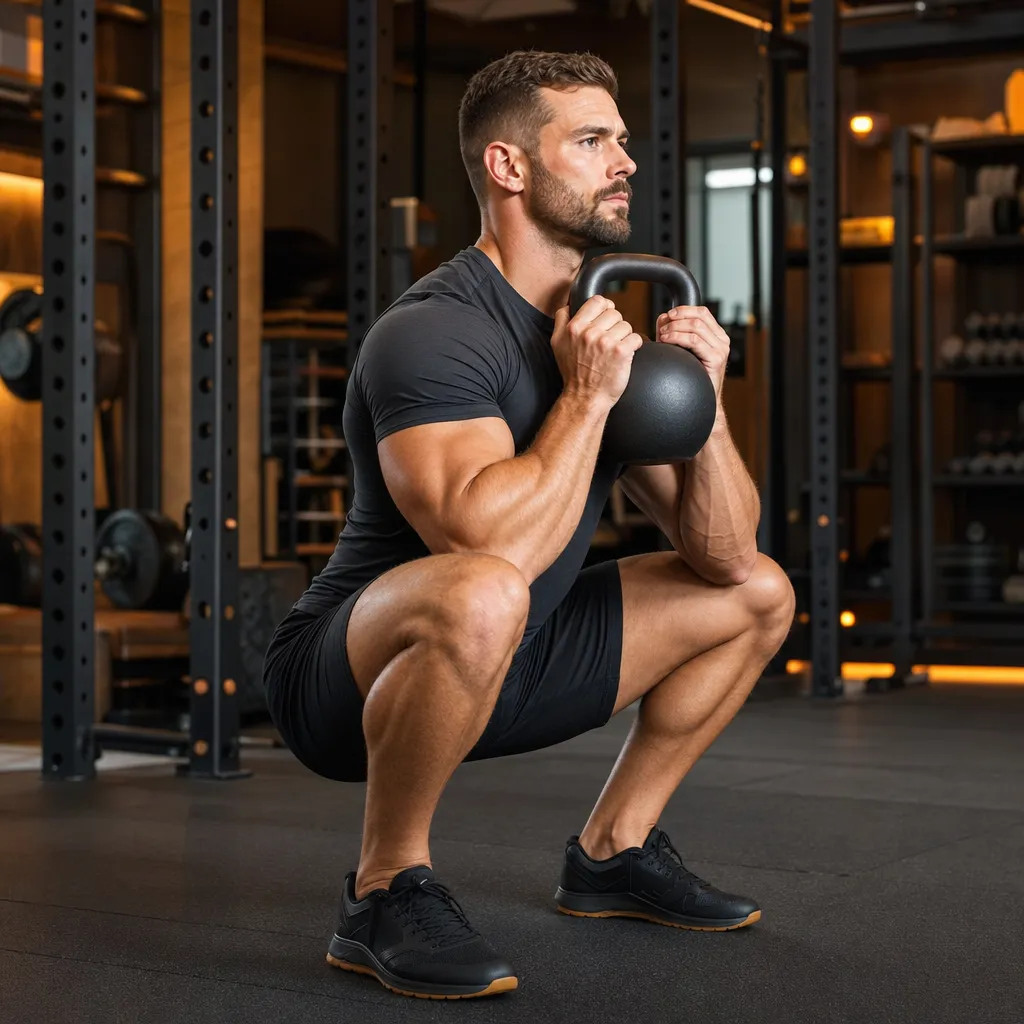
Kettlebell goblet squat bottom position, elbows inside knees and chest tall
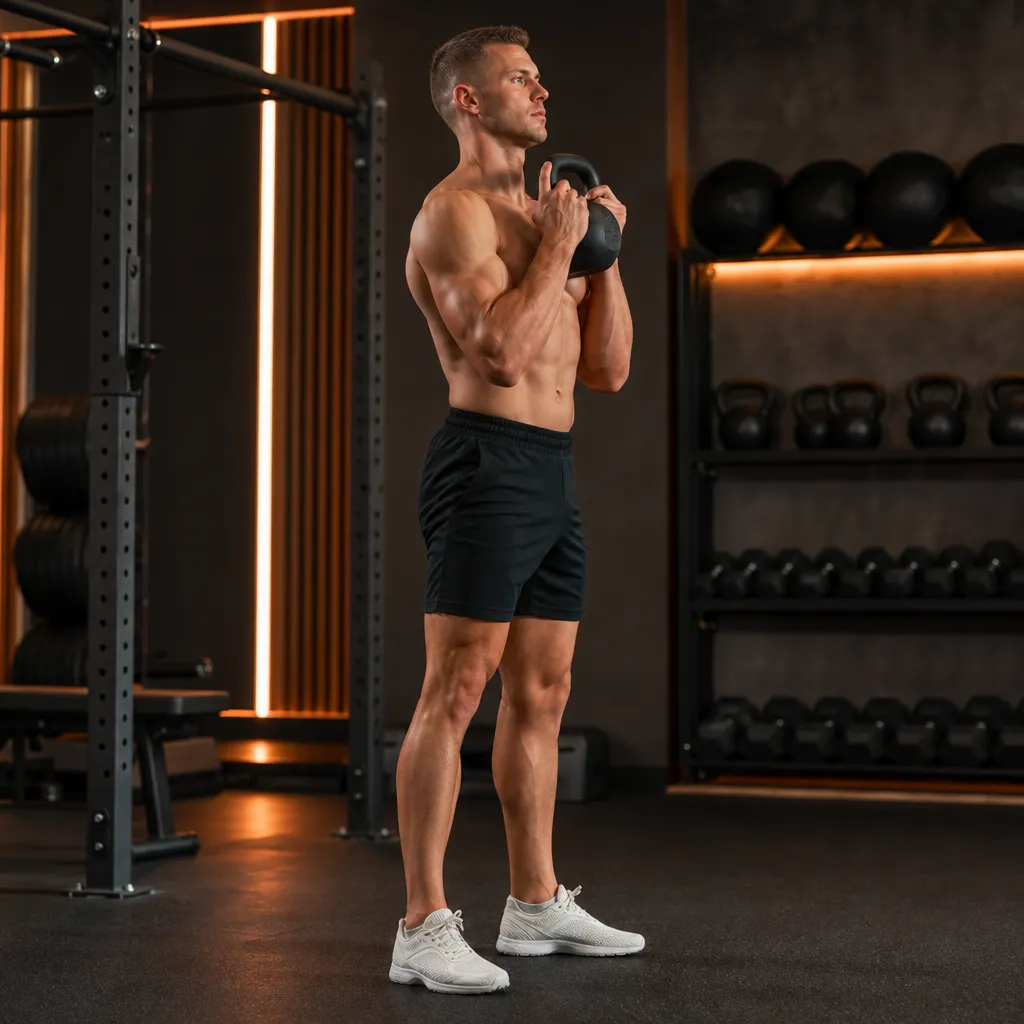
Kettlebell goblet squat standing position with glutes contracted
How to Program Swings and Goblet Squats Together
The two exercises cover the two foundational human movement patterns — hinge (swing) and squat (goblet squat). A complete kettlebell leg session uses both, alternated to fully fatigue the lower body without grinding any single muscle group into the ground.
Beginner Template (3x/week, 4-6 weeks):
- Goblet Squat: 3 sets of 8-10 reps, rest 90 seconds
- Kettlebell Swing: 5 sets of 10 reps, rest 60 seconds
- Optional: 1 set of bodyweight reverse lunges to failure each leg
Intermediate Template (2-3x/week, ongoing):
- Goblet Squat: 4 sets of 6-8 reps, rest 2 minutes
- Kettlebell Swing: 10 sets of 10 reps on the minute (EMOM, 10 minutes total)
- Bulgarian Split Squat (kettlebell goblet hold): 3 sets of 10 each leg
The order matters. Always do goblet squats before swings — squats are technique-heavy and benefit from a fresh nervous system, while swings are robust enough to perform under fatigue. Start lighter than you think for the swing: most lifters need at least 2-3 sessions to feel the hinge before they should add load.
What Are the Most Common Kettlebell Leg Training Mistakes
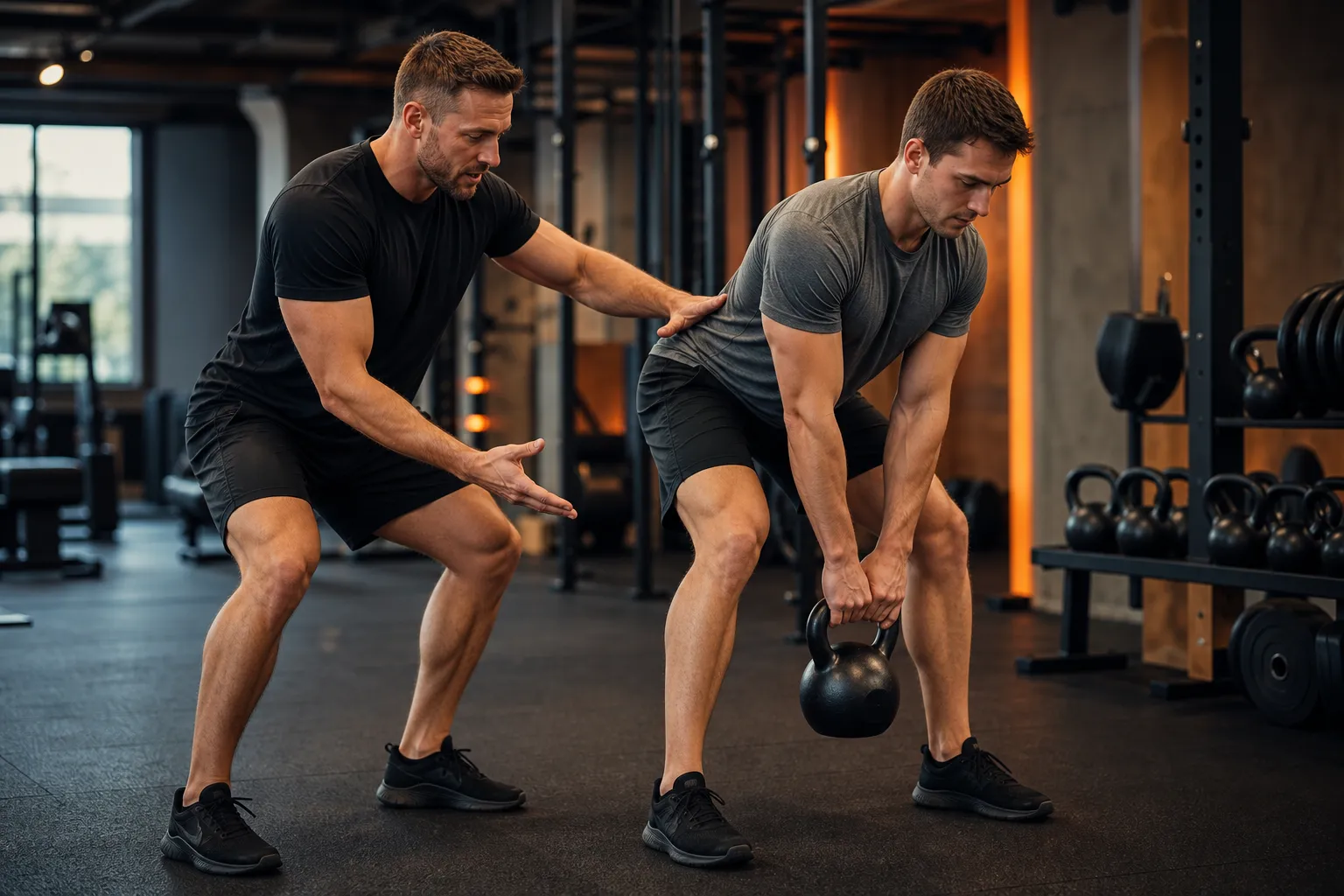
Avoid these errors and your hips, glutes, and lower back will stay healthy as you progress.
Swing: Squatting the swing. The most common error is bending the knees and lifting the bell up like a squat-to-press. The swing is a hinge — knees only bend slightly, and the dominant motion is at the hips. If your knees travel forward more than a couple of inches, you are squatting. Fix it by performing 10 hip hinges with no weight first, then adding the bell.
Swing: Lifting with the arms. The arms are ropes — they only connect the hips to the bell. If your shoulders are sore the day after a swing session, you were lifting with them. Cue: "the hips throw the bell." Let it float; do not lift it.
Swing: Letting the bell drop too low on the back-swing. The bell should travel above the knees on the back-swing, not down at ankle level. A low back-swing usually means you are squatting it down or losing your hinge angle. Keep the bell high and tight against your inner thighs.
Goblet Squat: Heels lifting off the floor. If your heels rise during the descent, your ankle mobility is limiting your range of motion. Reduce depth to where your heels stay grounded, or place small plates under your heels temporarily while you work on calf and ankle mobility.
Goblet Squat: Knees caving in. Knees collapsing inward (valgus) under load stresses the medial knee and indicates weak glutes or poor cueing. Drive your knees out toward your pinky toes throughout the lift. The "elbows inside knees" position at the bottom should feel like your elbows are gently pushing your knees out.
What Are the Key Takeaways
| Point | Recommendation |
|---|---|
| Why kettlebell for legs | Offset mass = perfect ballistic hinge tool; goblet squat = upright, deep squat pattern |
| Swing primary muscles | Glutes, hamstrings, erector spinae — posterior chain dominant |
| Swing key cue | Hinge, don't squat; hips drive, arms ride along |
| Goblet squat depth | Hip crease below knee, elbows inside knees, chest tall |
| Starting load | Men: 16 kg swing / 12 kg goblet; Women: 8-12 kg swing / 8 kg goblet |
| Programming order | Goblet squat first (technique), swings second (robust under fatigue) |
Quick mistake checklist:
- Swinging with bent knees — practice no-weight hinges first
- Lifting the bell with the shoulders — let the hips throw it
- Bell drops too low on back-swing — keep it high against inner thighs
- Heels lift on goblet squat — work ankle mobility, reduce depth
- Knees cave inward — drive them out toward the pinky toes
Recommended kettlebell leg session: Goblet Squat 4×8 + Kettlebell Swing 10×10 EMOM + Bulgarian Split Squat 3×10 each leg. Twice per week, this gives you a complete posterior chain and quad-dominant stimulus without needing a gym. For barbell variations on the same muscle group, see our barbell leg workout guide; for dumbbell options, see the dumbbell leg workout guide.
Frequently Asked Questions
What muscles does the kettlebell swing work?
The kettlebell swing primarily targets the posterior chain — glutes, hamstrings, and erector spinae — with significant secondary work from the lats, abs, and forearms. A 2012 study in the Journal of Strength and Conditioning Research found that the two-handed swing produces glute and hamstring activation comparable to traditional deadlift variations, plus a substantial cardiovascular demand that pure strength lifts do not match.
Is the kettlebell swing a leg exercise or a cardio exercise?
Both. The swing is a hip-hinge strength movement for the posterior chain, but performed for high reps or in EMOM-style intervals it doubles as one of the most effective conditioning tools available. For pure leg strength, do heavy 5×10 swings with full recovery. For conditioning, do 30-second on / 30-second off intervals for 10 minutes.
Kettlebell vs dumbbell for legs — which is better?
They serve different purposes. Dumbbells are better for unilateral work (lunges, split squats) and can be loaded heavier than most kettlebells. The kettlebell wins decisively for the swing — its offset center of mass makes ballistic hinge movements safer and more natural than the same motion with a dumbbell. The best approach is to use both: kettlebell for swings and goblet squats, dumbbells for lunges and Romanian deadlifts.
How heavy should my kettlebell be for swings and goblet squats?
Beginner men typically start with 16 kg (35 lb) for swings and 12-16 kg for goblet squats. Beginner women start with 8-12 kg for both. The swing benefits from a heavier bell than most beginners assume — once technique is solid, men should progress to 24 kg and women to 16 kg, where the posterior chain is meaningfully challenged.
Can you build muscle in your legs with just a kettlebell?
Yes, especially for beginners and intermediates. The goblet squat and Bulgarian split squat with a kettlebell produce hypertrophy comparable to barbell variations at equivalent relative loads. The ceiling is lower than a barbell — you eventually outgrow available kettlebell weights for squat patterns — but for the first 1-2 years of training, a single kettlebell is enough to build a strong, athletic lower body.
References & Sources
1RM Calculator (One-Rep Max)
Estimate your one-rep max (1RM) - the maximum weight you can lift for a single repetition - from a weight you can lift for multiple reps. The calculator uses the Epley and Brzycki equations and averages them.
Strength Standards Calculator
How strong are you compared to other lifters? Enter your bodyweight and best lift to see where you rank - from Beginner to Elite - on the bench press, squat, deadlift, and overhead press. Standards are scaled to your bodyweight, so a 60 kg lifter and a 100 kg lifter are judged fairly.
Protein Intake Calculator
Calculate how much protein you need each day based on your body weight and training goal. This calculator uses the research-backed range of 1.6 to 2.2 grams of protein per kilogram of body weight for building muscle.